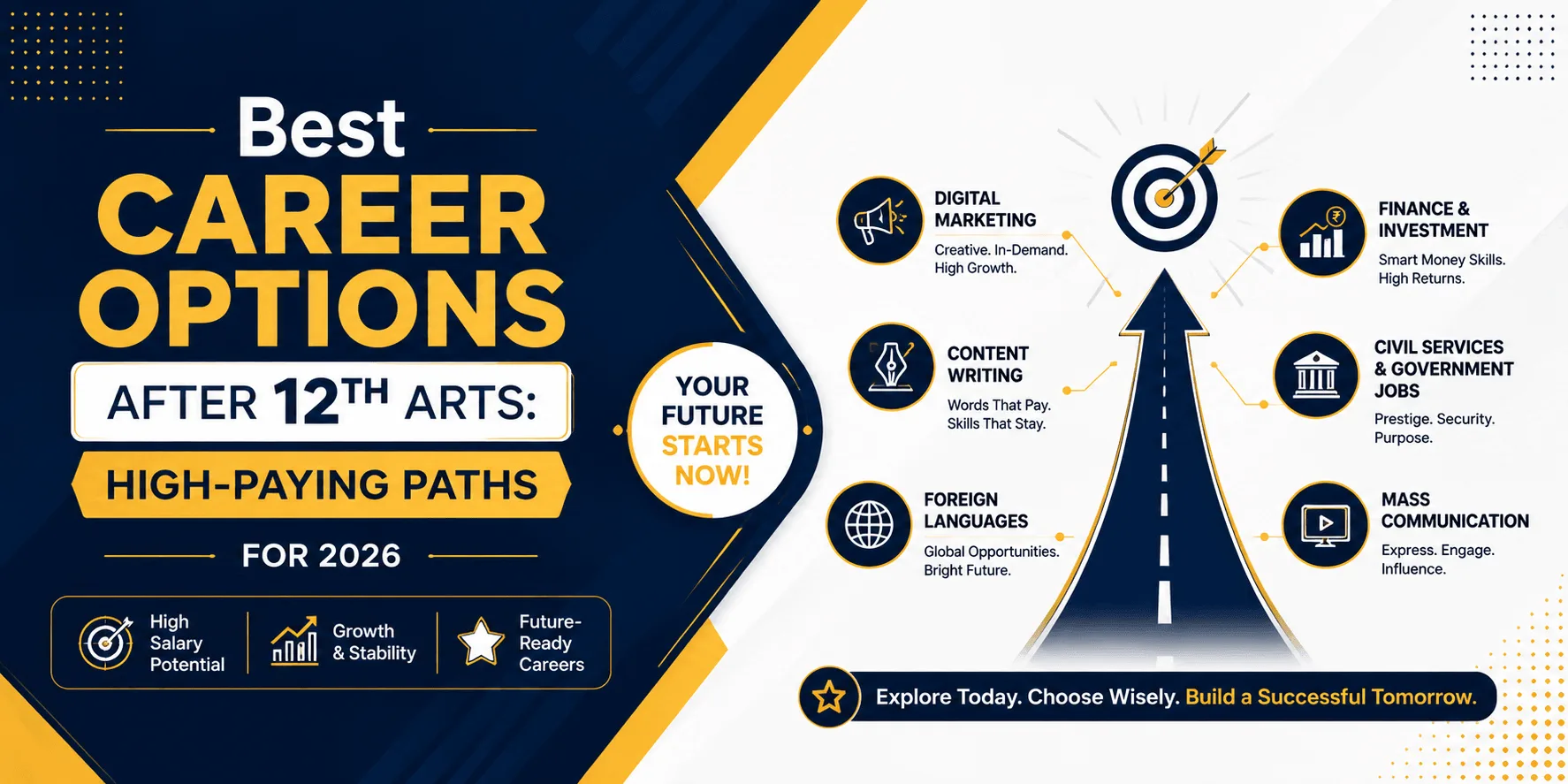
The best career options after 12th Arts are no longer confined to a small group of traditional professions. Students can build careers across law, design, business, psychology, media, policy, research, and technology-enabled roles. However, the right choice depends on more than earning potential. Interest, aptitude, required qualifications, future demand, and the skills a student is willing to develop all play a role.
Here are some of the most promising arts stream career options after 12th to consider in 2026.
1. Law and Legal Careers: A High-Paying Career Option After 12th Arts
Law remains a strong option for students who enjoy argument, research, writing, and understanding how institutions and businesses operate. An integrated law degree can lead to careers in corporate law, litigation, intellectual property, compliance, technology law, and regulatory affairs. Students with an interest in business can also explore the intersection of law, finance, and entrepreneurship. Over time, specialised legal expertise can create significant career and earning opportunities.
2. Design and Creative Careers
Design is one of the most diverse arts career options after 12th, particularly for students who enjoy creative problem-solving. The field now extends beyond traditional graphic or fashion design into UX, product design, interaction design, service design, and design strategy. Designers increasingly work alongside engineers, marketers, researchers, and business teams. Building a strong portfolio and developing digital skills can be just as important as formal qualifications in many design careers.
3. Business and Entrepreneurship: Career Options After 12th for Arts Students
Arts students can also move into business, management, and entrepreneurship through undergraduate programmes in business and related disciplines. Careers can span marketing, business development, strategy, product management, consulting, and operations. An understanding of people, communication, culture, and consumer behaviour can be particularly useful in business environments. For students who prefer creating opportunities rather than following a conventional career path, entrepreneurship offers another possibility.
4. Psychology and Behavioural Science
Psychology can be a meaningful choice for students interested in understanding how people think, behave, and make decisions. Beyond conventional psychology-related professions, this knowledge can be applied to consumer research, organisational behaviour, human resources, behavioural research, and UX research. Some specialised professional roles require postgraduate qualifications, so students should consider the complete educational pathway before choosing this field. The combination of psychology with business or technology can also open up newer career directions.
5. Digital Marketing and Brand Strategy: Growing Arts Stream Jobs
Digital marketing has created a wide range of
arts stream jobs for students with strong communication and creative skills. Roles include content strategy, copywriting, social media, SEO, brand management, performance marketing, and consumer insights. The field is becoming increasingly data-driven, making analytics and AI literacy valuable additions to creative abilities. Students who combine storytelling with an understanding of consumers, platforms, and business outcomes can progress into strategic roles.
6. Media, Journalism and Communication
Media has expanded well beyond newspapers, television, and traditional publishing. Today's opportunities include digital journalism, video production, corporate communication, public relations, content strategy, podcasting, and brand storytelling. Students entering this field benefit from combining strong writing and storytelling abilities with digital production and audience analysis. The ability to understand how content is created, distributed, and consumed has become increasingly important.
7. Economics and Research: After 12th Arts Career Options With Analytical Depth
Economics can be a strong pathway for students interested in markets, policy, business, and research, subject to the eligibility requirements of the programme they choose. Adding quantitative skills such as statistics, data analysis, and econometrics can significantly broaden career opportunities. Graduates can explore research, consulting, market intelligence, analytics, finance, and policy-related roles. This is a good example of how an Arts foundation can become more powerful when combined with technical skills.
8. Public Policy and International Relations
Students interested in governance, politics, diplomacy, and global affairs can explore public policy and international relations. Potential careers include policy research, think tanks, public affairs, development organisations, government-related work, and international institutions. These fields often reward strong research, writing, analytical, and communication skills. Specialising in areas such as technology policy, climate policy, international trade, or AI governance can create more focused career pathways.
9. UX Research and Human-Centred Technology
UX research is one of the newer
after 12th Arts career options emerging at the intersection of human behaviour and technology. UX researchers study how people interact with digital products through interviews, usability testing, surveys, and behavioural research. Students with backgrounds or interests in psychology, sociology, communication, or design can build relevant skills for this field. It also offers an opportunity to work closely with product managers, designers, engineers, and business teams.
10. Fashion, Luxury and Creative Industries: Arts Stream Jobs With Commercial Scope
Fashion and luxury offer career possibilities that extend well beyond designing clothes. Students can explore fashion communication, merchandising, buying, retail, brand management, luxury marketing, styling, and creative production. The industry increasingly requires professionals who understand both creative expression and commercial strategy. Combining knowledge of consumer behaviour, branding, digital media, and design can therefore create broader career opportunities.
These arts career options with salary potential differ considerably in terms of qualifications, starting pay, work environment, and long-term progression. Instead of choosing purely on the basis of which profession appears to pay the most, students should consider which field aligns with their strengths and which skills they are prepared to develop over the next several years.