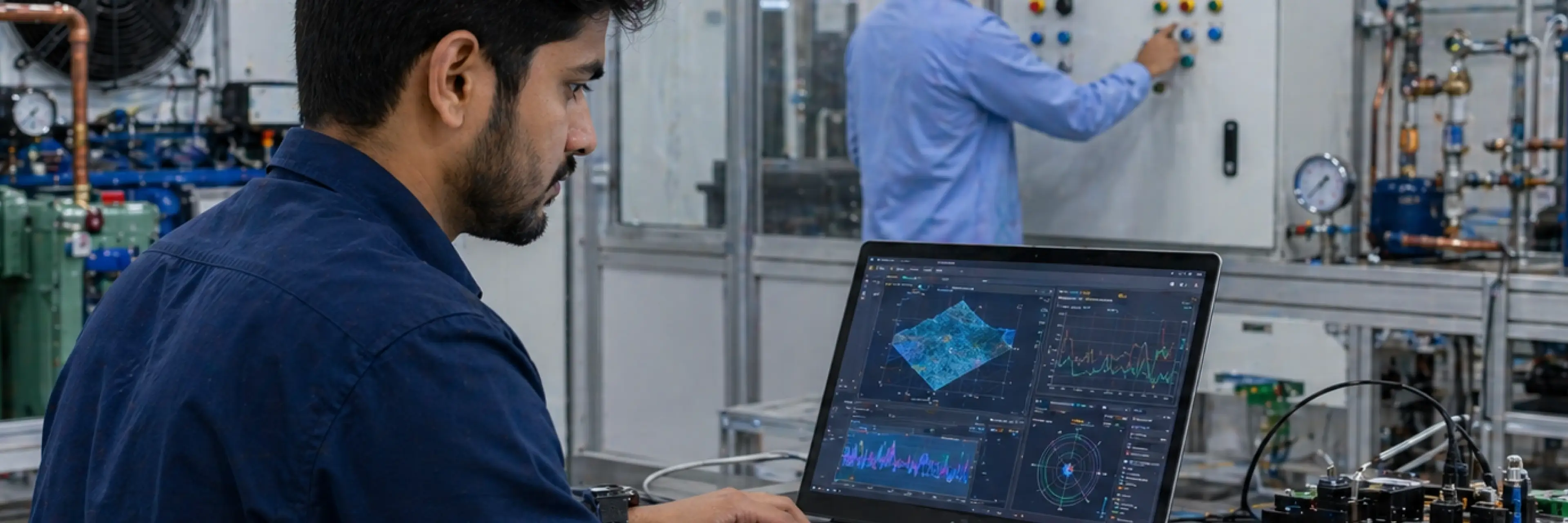
The rise of artificial intelligence has changed more than just the job market. It is reshaping the way universities design engineering education itself. For years, a traditional BTech in Computer Science curriculum focused on building a strong base in software development, computational logic, and system design. These remain essential. But as industries rapidly adopt AI-driven tools and automation, universities are being pushed to rethink what future-ready education should look like.
Today, a modern B Tech Computer Science program is no longer limited to teaching students how to code or build software applications. It is increasingly designed to help students understand intelligent systems, work with machine learning models, and create AI-powered solutions for real-world challenges. This evolution is visible in the way curriculums now combine core engineering principles with AI-focused modules, interdisciplinary electives, project-based learning, and hands-on labs.
Rather than treating artificial intelligence as an optional specialization, many institutions are integrating it into the mainstream learning journey. This ensures students graduate with both strong fundamentals and the ability to adapt to rapidly changing technologies.
Here is how modern B Tech Computer Science Engineering curriculums are evolving.
Programming and Computational Thinking in BTech in Computer Science
Every AI system begins with programming. Before students can build intelligent tools or work with machine learning models, they need to develop a strong understanding of logic, problem-solving, and computational thinking. This is often where the journey starts in a B Tech in Computer Science & Engineering program.
Students are introduced to programming languages such as Python, Java, and C++, each serving different purposes in software development and AI applications. Python, in particular, has become one of the most important languages in AI development because of its simplicity and its powerful ecosystem of libraries and frameworks. Students often learn to work with tools such as TensorFlow and PyTorch for deep learning, Scikit-learn for machine learning, and Hugging Face Transformers for natural language processing and large language models.
Beyond syntax, students are taught how to think like engineers. They learn how to break down complex problems into smaller steps, design algorithms, test solutions, and optimize performance. This computational thinking becomes the foundation for everything they build later in AI and software engineering.
Mathematics for AI in B Tech Computer Science Engineering
Behind every AI model is mathematics. Generative AI may appear creative on the surface, but underneath it relies on mathematical models that determine how systems process information, identify patterns, and generate outputs. This is why mathematics remains a critical part of a modern BTech CS curriculum.
Students typically study concepts like linear algebra, which helps represent and manipulate data in vectors and matrices. Probability and statistics help models make predictions and understand uncertainty. Calculus plays a key role in optimization and training neural networks, while optimization techniques help improve model performance over time.
Understanding these concepts helps students move beyond simply using AI tools. It allows them to understand why models behave in certain ways, how training works, and how performance can be improved. This deeper understanding is especially important for students interested in advanced AI research or product development.
Machine Learning and Deep Learning
Machine learning and deep learning form the backbone of modern AI education. In many universities, students pursuing CSE AI and ML or B Tech CSE AI ML specializations study these subjects in depth as part of their curriculum. Machine learning introduces students to systems that can learn patterns from data and make decisions or predictions without being explicitly programmed for every task.
Students typically learn the difference between supervised learning, where models are trained on labeled data, and unsupervised learning, where systems identify hidden patterns on their own. They may also study reinforcement learning, where models learn through rewards and penalties. As students progress, they move into deep learning, which uses multi-layered neural networks to solve more complex tasks.
This includes understanding neural networks for general learning tasks, convolutional neural networks for image-related tasks, recurrent neural networks for sequential data like speech or text, and transformer architectures that power modern Generative AI tools such as ChatGPT. These concepts form the technical foundation for building AI applications in areas like automation, language generation, recommendation systems, and predictive analytics.
Natural Language Processing (NLP)
Language is one of the most exciting frontiers of Generative AI. Since many modern AI tools are built around understanding and generating text, speech, and conversation, Natural Language Processing has become a core area of study in many B Tech Computer Science Engineering programs. NLP teaches students how machines interpret human language and respond meaningfully.
Students may learn how AI performs sentiment analysis to understand opinions and emotions in text, language translation to convert content between languages, text summarization to simplify long documents, and conversational AI to build chatbots and virtual assistants. With the rise of large language models, students may also explore tokenization, embeddings, transformers, and prompt engineering. These skills are increasingly valuable because businesses across industries are using language-based AI tools for customer support, content generation, education, and workflow automation.
Computer Vision in BTech in Computer Science Engineering
Generative AI is not limited to text. It is also transforming the way machines interpret and create visual content. Computer vision teaches machines to "see" and understand images and videos in a meaningful way. In modern BTech in Computer Science programs, this has become an increasingly important subject.
Students learn concepts such as image recognition, where systems identify objects or patterns in images; object detection, where machines locate multiple items within a visual frame; and image synthesis, where AI creates entirely new visuals. Students may also study technologies like GANs, or Generative Adversarial Networks, which are used to generate realistic images, videos, and simulations. These skills are widely used in industries such as healthcare for medical imaging, retail for visual search, autonomous vehicles for navigation, and entertainment for content creation.
AI Ethics and Responsible Innovation
As AI becomes more powerful, the responsibility to build it ethically becomes equally important. Universities are increasingly recognizing that technical skills alone are not enough. Students need to understand the social, ethical, and legal implications of the technologies they create.
That is why AI ethics and responsible innovation are becoming a key part of modern engineering curriculums. Students are encouraged to think critically about issues such as bias in AI models, which can lead to unfair or inaccurate outcomes. They learn about data privacy and how personal information should be collected, stored, and used responsibly.
They may also explore intellectual property concerns around AI-generated content and the challenges of deploying AI systems safely in real-world environments. This kind of education ensures students do not just become capable engineers. It helps them become responsible innovators who can build technology that is fair, transparent, and socially beneficial.
Also Read: Top Companies Hiring BTech Robotics Graduates in India