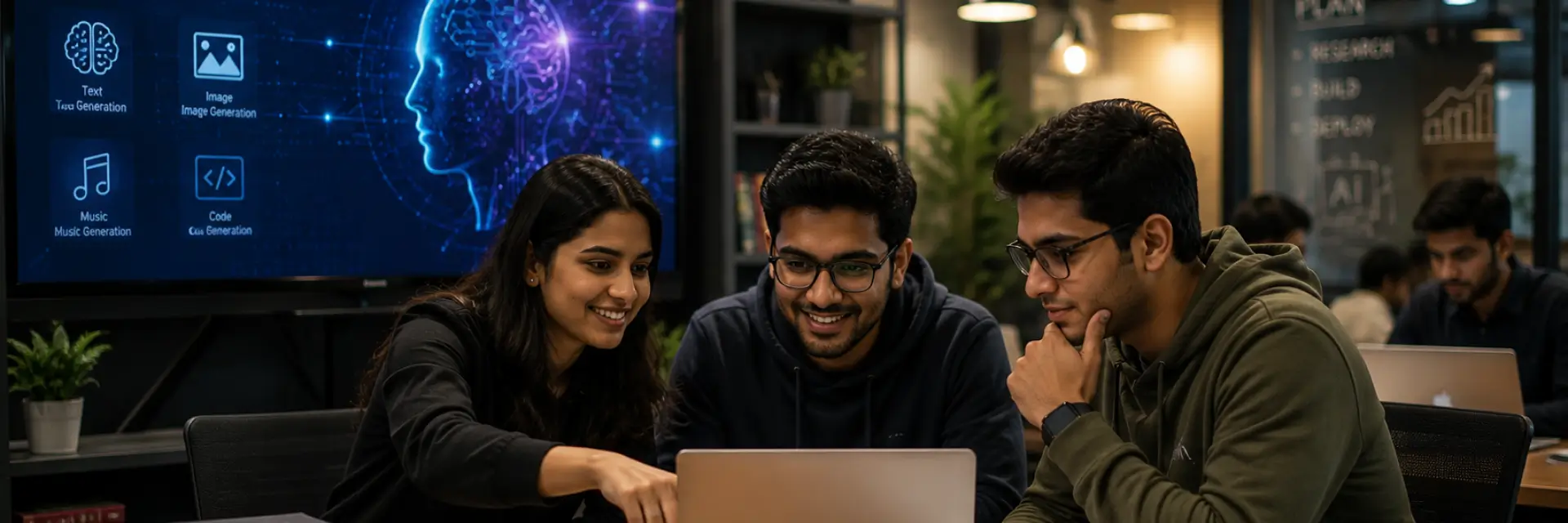
The easiest way to understand generative AI is to look at how it's already being used across industries.
In software engineering: GitHub Copilot and similar tools write and suggest code directly inside a developer's editor. Instead of spending hours writing repetitive boilerplate code, developers can review AI-generated functions and focus on architecture, debugging, and solving complex problems.
In marketing and content: Companies use generative AI to create first drafts of articles, generate multiple ad variations, personalise landing pages for different audience segments, and produce images and videos without relying on large production teams.
In customer support: Generative AI drafts responses to customer queries, powers conversational chatbots, and summarises lengthy customer interactions so human agents can resolve complex cases more quickly.
In product design and engineering: Generative design, a specialised application of AI, helps engineers explore thousands of design possibilities based on factors like weight, material, cost, and durability. Autodesk's generative design tools, for example, have been used to create components for NASA's next-generation moon lander and lightweight shoe soles for New Balance. Engineers define the requirements, and the AI generates multiple optimised solutions.
In healthcare and life sciences: Generative AI is helping researchers accelerate drug discovery by creating molecular structures with potential therapeutic properties, reducing the time needed for early-stage research.
In education: AI-powered learning platforms personalise study plans, adjust difficulty levels based on a student's progress, and provide instant feedback to improve learning outcomes.
Across all these examples, the pattern is clear. Generative AI excels at handling large volumes of repetitive work and identifying patterns. Humans still provide judgment, context, creativity, and the final decision. This human-in-the-loop approach has become the standard way organisations deploy AI in professional environments in 2026.