Step 1: Build Your Class 11-12 Foundation Right
Robotics engineering at the undergraduate level requires Physics, Chemistry, and Mathematics (PCM) in Class 11 and 12. This is non-negotiable for most B.Tech admissions.
Within PCM, give extra attention to:
Minimum eligibility at most B.Tech Robotics programs is 50 to 60% aggregate in Class 12 PCM. Top tier private universities typically set 60% as the floor.
Step 2: Clear the Right Entrance Exams
Admission to
B.Tech robotics and automation programs in India is entrance exam driven. The key exams:
Private university robotics programs increasingly test logical reasoning and computational thinking alongside the core PCM syllabus, a direct signal that these programs want students who can think in systems, not just recall formulas.
Step 3: Choose the Right B.Tech Program (This Decision Matters More Than You Think)
Three B.Tech pathways lead to a robotics engineering career. B.Tech Robotics and Automation covers mechanical and control systems, and suits students targeting manufacturing and automotive automation.
B.Tech in Robotics and Artificial Intelligence adds machine learning, computer vision, and autonomous systems, and suits students aiming for AI-driven robotics and deep-tech startups. B.Tech in Mechatronics or Mechanical with a robotics specialisation offers a broader mechanical base, a safer option for students still deciding how far to specialise.
In 2026, Robotics and AI is the more future-proof pick. Most high-value opportunities now sit at the intersection of hardware and AI, from autonomous vehicles to AI-driven surgical systems. A program that integrates both from Year 1 beats one that saves AI for a final-semester elective.
Before choosing, check for a functioning robotics/AI lab, research-active faculty, and partnerships that actually produce internships. Location matters too. A campus in BKC, walking distance from 500+ companies, gives access to recruiters and campus visits alone can't be replicated. ATLAS uGDX's B.Tech sits on a 5-acre BKC campus for exactly this reason. Students aren't building toward industry access; they're already inside it from Day 1.
Step 4: Build the Core Technical Skills (Years 1-4 and Beyond)
Coursework builds the foundation, but hireability comes from labs and self-driven projects. Five skills matter most in 2026: programming (Python for AI/ML, C/C++ for embedded systems, ROS from Year 2), control systems (PID controllers and feedback loops), embedded systems (sensors, actuators, Arduino, Raspberry Pi), machine learning and computer vision (OpenCV, TensorFlow/PyTorch, now standard rather than advanced), and CAD and simulation (SolidWorks, Gazebo, MATLAB/Simulink).
Step 5: Stack Experience While You Study
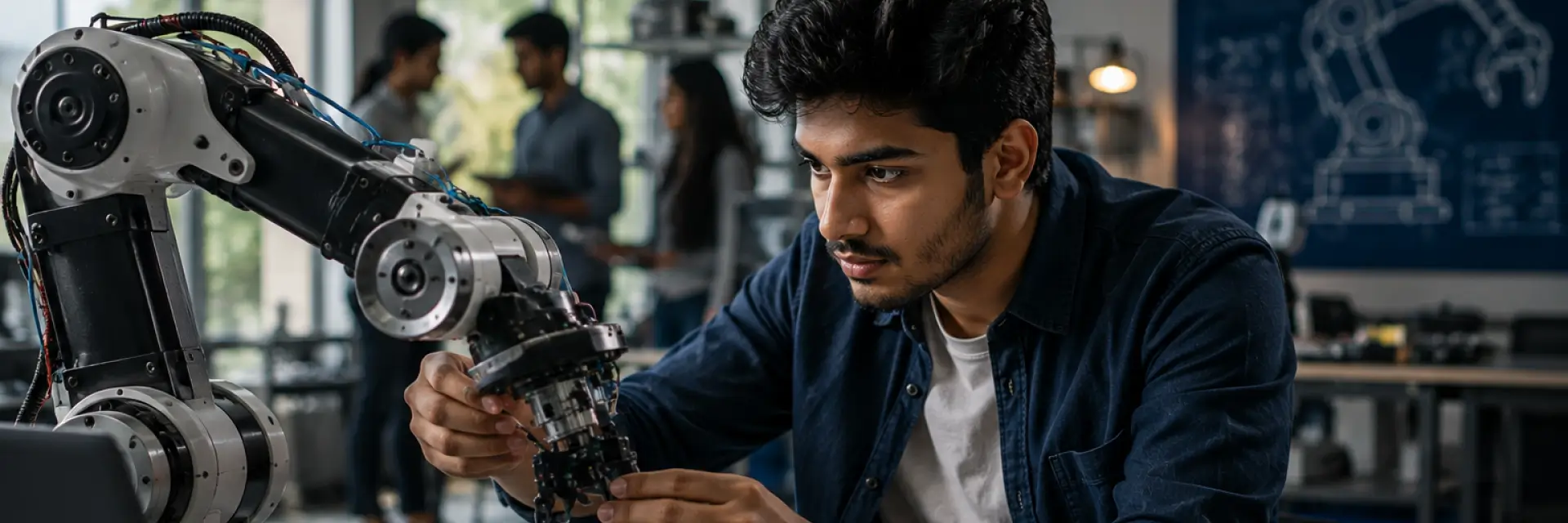
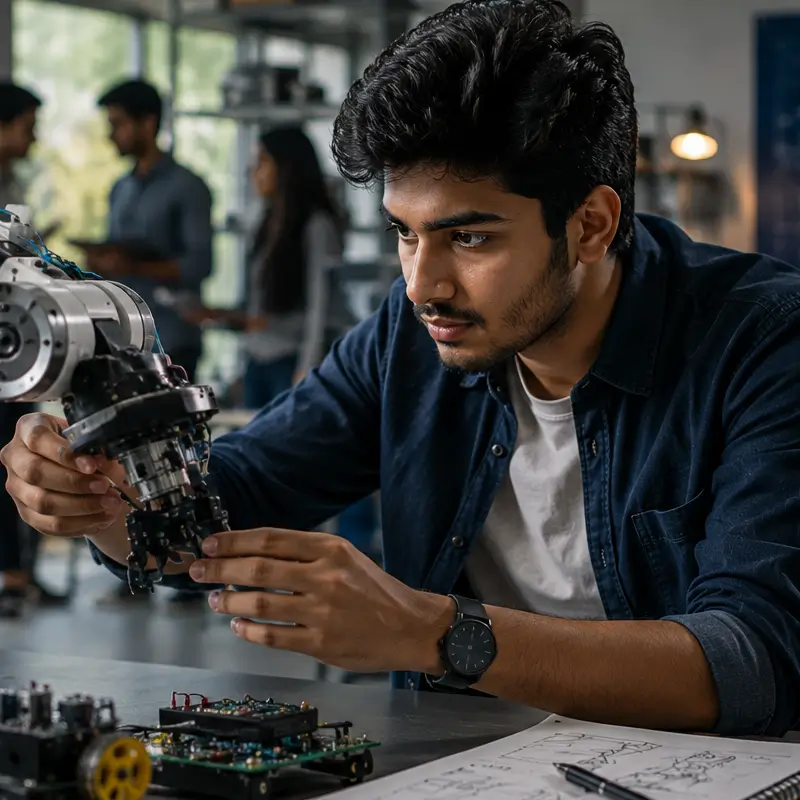
A B.Tech in Robotics without projects is a degree without proof. Build something every semester: a line-following robot in Year 1, a robotic arm in Year 2, a vision-guided pick-and-place system in Year 3. Document it on GitHub and LinkedIn.
Intern where the robots actually are, at firms like ABB, Fanuc, Bosch, Mahindra, and Tata Motors, not just companies with "automation" in their job title. Certifications like ROS Developer or MATLAB Robotics Toolbox won't replace the degree, but they signal you took the four years seriously.
Step 6: Enter the Job Market with a Plan
By graduation, your job search should be half done. Roles open to freshers include Robotics Engineer, Automation Engineer, Control Systems Engineer, and Robotics Research Engineer at places like DRDO, ISRO, and HAL.
Fresher salaries run ₹4-7 LPA in manufacturing and automation, and ₹5-9 LPA in deep-tech and AI-driven roles, with Mumbai, Pune, and Bengaluru indexing higher. Within 3-5 years, strong Python, ROS, and machine learning skills can push this to ₹12-18 LPA, with senior robotics architects now earning meaningfully above most conventional engineering tracks.