The engineering industry is going through a major transition. For decades, the traditional model of technical education focused heavily on theoretical learning, standardized curricula, and degree completion. But industries today are evolving much faster than academic structures were originally designed for.
The rise of AI, automation, intelligent systems, and digital transformation has changed not only the nature of technology jobs, but also the kind of professionals companies want to hire. Employers are increasingly looking for graduates who can adapt quickly, solve real-world problems, and work across disciplines instead of relying only on textbook knowledge.
This changing landscape is one of the key reasons why programmes like integrated btech and mtech and 5 year integrated m tech pathways are gaining attention among students looking for more future-focused learning models.
1. From Degrees to Capability: What Integrated BTech MTech Delivers
A strong degree still matters, but it is no longer the only differentiator in the technology industry. Employers today are placing greater emphasis on capability over qualification alone. Companies want professionals who can think critically, adapt to changing technologies, and contribute meaningfully from the start.
This shift has become even more visible with the rise of AI-driven workflows and automation. Routine technical tasks are increasingly being handled by intelligent systems, which means human value now lies in problem-solving, creativity, systems thinking, and innovation. Students are therefore expected to build practical expertise alongside academic knowledge.
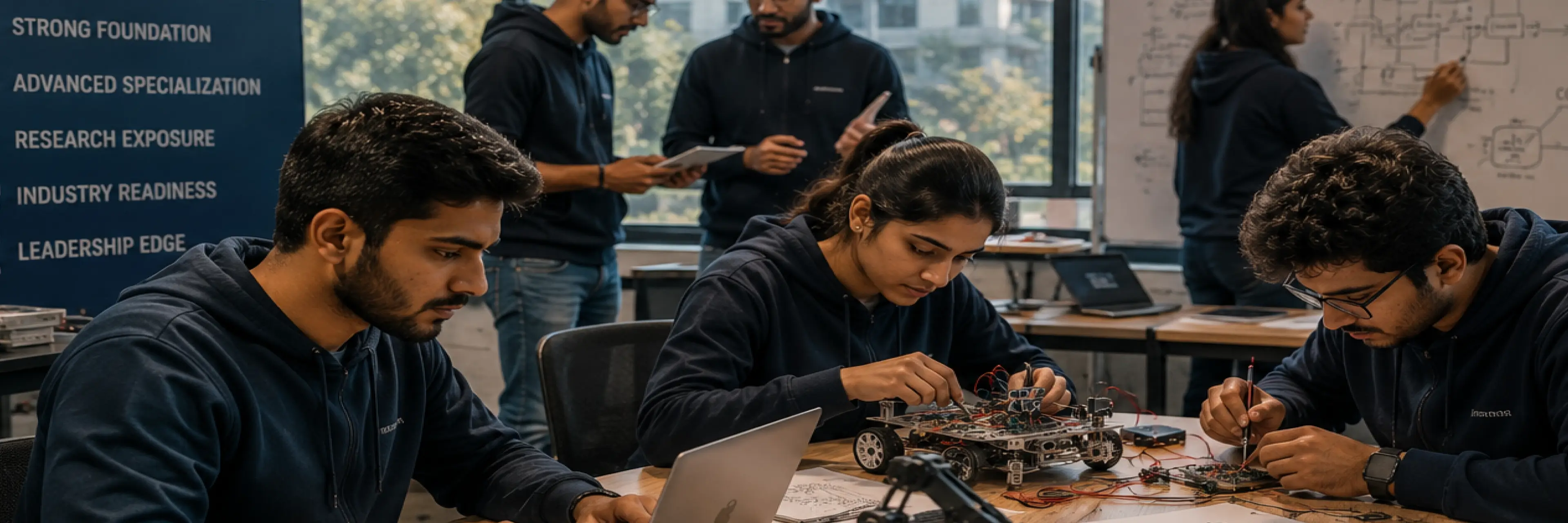
This is where integrated learning pathways become relevant. A b tech m tech integrated programme creates more room for deeper learning, advanced specialization, research exposure, and long-term skill development instead of limiting education to short-term academic outcomes.
2. Why Specialisation in Integrated BTech in AI and CS Starts Earlier Now
Technology careers today are becoming increasingly specialized. Industries are actively hiring talent with expertise in areas such as artificial intelligence, machine learning, cloud computing, cybersecurity, and intelligent systems.
As a result, many students are choosing programmes like integrated b tech in ai and integrated b tech in cs to build focused expertise earlier in their academic journey. In traditional engineering pathways, advanced specialization often begins only after graduation or during postgraduate education. But in rapidly evolving industries, students who gain exposure to emerging technologies earlier often develop stronger industry readiness and technical confidence.
Integrated programmes help bridge this gap by allowing students to gradually move from foundational engineering concepts into advanced technology domains within a continuous learning framework. This creates stronger alignment between academic learning and future industry expectations.
3. Technology Careers Are Becoming More Interdisciplinary
Technology no longer functions in isolation. Today's engineers often work alongside business strategists, product teams, designers, data analysts, and entrepreneurs. As industries become more innovation-driven, professionals are increasingly expected to understand both technical systems and broader business realities. This shift is one of the reasons interdisciplinary pathways like integrated b tech and mba are gaining popularity.
Modern technology roles require professionals who can not only build systems, but also understand user behaviour, market needs, scalability, and strategic decision-making. Companies are looking for individuals who can connect technology with real-world impact. As a result, engineering education itself is becoming more interdisciplinary, blending technology with design thinking, entrepreneurship, leadership, and innovation-focused learning.
4. Long-Term Career Readiness and the Rise of 5-Year Integrated MTech Path
Students today are approaching higher education differently than previous generations. Instead of choosing degrees based only on placements or convention, many are evaluating how well a programme prepares them for long-term industry shifts and emerging technologies. This growing future-focused mindset is also contributing to the rise of integrated m tech pathways. Students increasingly want educational experiences that offer continuity, industry exposure, practical learning, and adaptability in a rapidly changing job market.
The focus is no longer simply on earning a qualification. Students are looking for learning ecosystems that help them develop technical depth, interdisciplinary thinking, research exposure, and the ability to continuously evolve alongside technology itself. And in many ways, that is exactly where integrated learning models are becoming far more relevant than traditional approaches.
Also Read: BBA in AI: Is Artificial Intelligence Changing How Business Works?