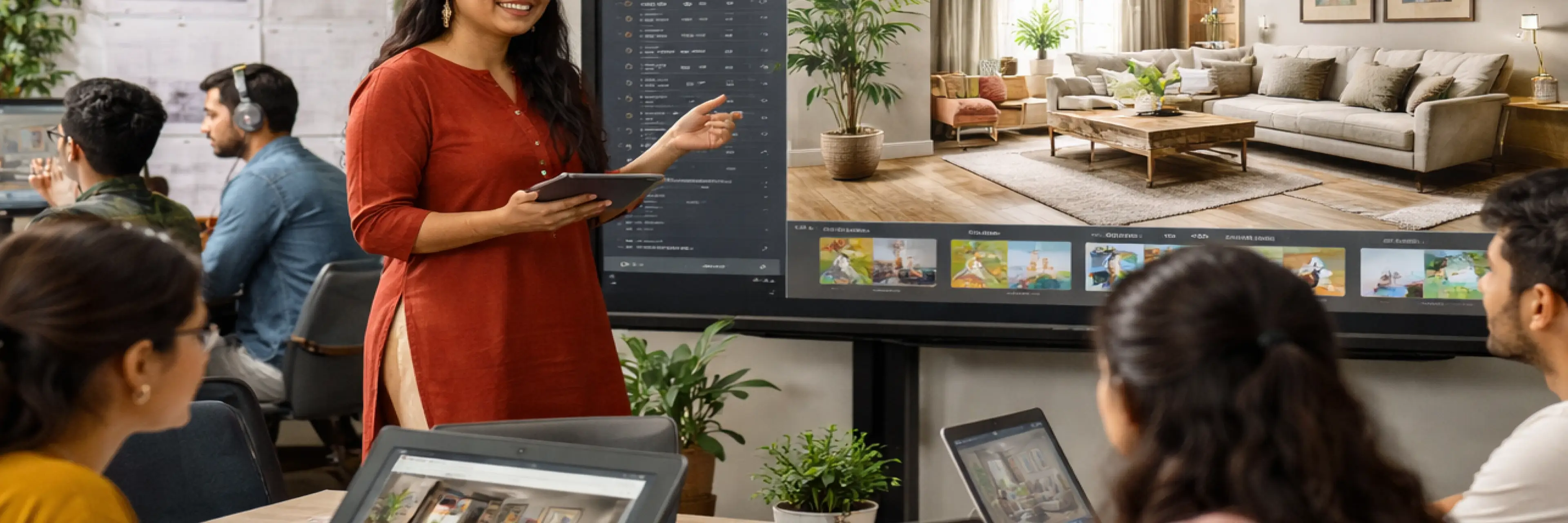
There is a growing concern in design education that AI might flatten creativity. The fear is simple. If every student has access to the same tools, templates, and generative systems, will the outcomes start to look similar? It is a fair question, especially in a field like interior design where originality, intuition, and personal expression have always mattered deeply.
In practice, though, something different is unfolding. AI is not narrowing creativity. It is expanding the entry points into it. For students working within a B Des Interior Design or a bachelor of interior design degree, AI becomes less about producing final answers and more about opening up possibilities that would have been difficult to explore otherwise. Ideas that once required hours of manual iteration can now be tested in minutes. Complex spatial configurations, unconventional material combinations, and unexpected lighting scenarios can be visualised early in the process, allowing students to explore directions they might not have considered at all.
What changes is not the presence of creativity, but the way it is exercised. The emphasis shifts from effort spent on execution to clarity of thought and intent. In an environment shaped by AI in interior design, the quality of output depends less on technical skill alone and more on how well a student can frame a problem, guide the tool, and interpret what comes back. A vague input produces a generic result. A thoughtful, well-contextualised prompt can lead to surprising and meaningful directions.
This turns interior design using AI into a continuous dialogue rather than a one-way process. The student is no longer simply drawing or modelling in isolation. They are interacting with a system that responds, challenges, and sometimes even disrupts their expectations. The creative act becomes iterative, layered, and more reflective. Instead of committing to a single idea too early, students are encouraged to explore multiple versions, compare outcomes, and refine based on reasoning rather than habit.
Far from making design uniform, this actually increases variation in thinking. The real differentiator becomes not the tool itself, but how each designer uses it. Two students can work with the same interior design AI tools and arrive at entirely different outcomes based on their understanding, sensitivity, and ability to make decisions. This is where creativity shifts from execution to direction, from producing form to shaping meaning.
In this sense, AI is not replacing originality. It is testing it. And for students learning within an interior design degree, that pressure can be a powerful catalyst for deeper, more intentional design thinking.